

Europe needs to get real on defence; Britain needs to get real on Europe
13 February 2025


Post
13 March 2009

3 minute(s) read
Recent Posts
Kim Leadbeater, MP: My Sister’s Murder and Why I Never Wanted To Go Into Politics
This week, we bring you one of Alastair’s favourite interviews. He’s joined by Kim Leadbeater MP, whose sister Jo Cox was murdered in 2016, and his lifelong friend Lindsay Nicholson, who lost her ... Continue23 October 2026
Posted by Alastair Campbell

582. Netanyahu’s Fight for Survival and the Gaza Film That Shocked Rory and Alastair
What is at stake for Israelis and Palestinians in the upcoming parliamentary elections and, if Netanyahu loses, will anything actually change given the major parties reject a two state solution? Why d... Continue22 October 2026
Posted by Alastair Campbell

Alastair Campbell’s diary: The truth that Northern Ireland has never confronted
The annual crisis over Protestant marches might have been avoided had we followed Mandela’s example... Continue
21 October 2026
Posted by Alastair Campbell
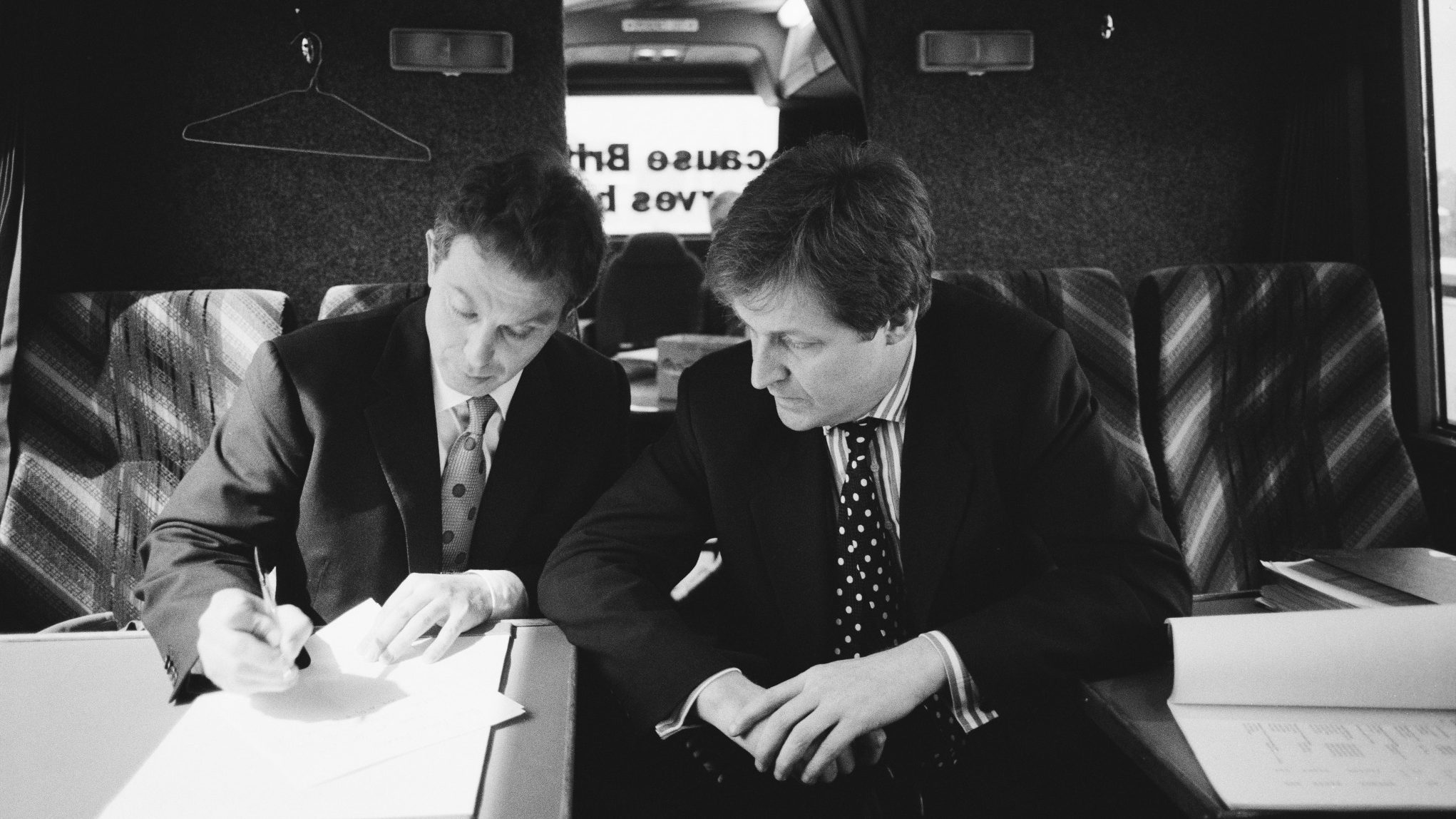
EXCLUSIVE EXTRACT: The art of surviving a political crisis
In an exclusive extract from his brilliant new book Persevilience, Alastair Campbell reflects on his time at the heart of the New Labour media operation, and what it taught him... Continue
21 October 2026
Posted by Alastair Campbell

EXCLUSIVE EXTRACT: The power of talking to dead people
Our parents, friends and colleagues pass away – but their memories, their values and the advice we think they would give us live on... Continue
21 October 2026
Posted by Alastair Campbell

581. Trump and Putin vs. Zelensky: Is Europe Sleepwalking into Disaster?
After another devastating week for Ukraine, is Trump now firmly on Putin’s side, and how much leverage does Elon Musk have over Zelensky’s war effort through his ownership of Starlink? With more c... Continue21 October 2026
Posted by Alastair Campbell
211. Trump’s Niece on Why He’s On Putin’s Side
How did Donald Trump’s childhood shape the president we see today? Why was Mary Trump cut out of her grandfather’s billion-dollar will? Why does he want to see Europe fail? Alastair and Rory are j... Continue19 October 2026
Posted by Alastair Campbell

Addiction, Breakdown and Finding Persevilience: Rory Interviews Alastair
How has Alastair managed to come back from some of the darkest places in his life, overcoming a breakdown while in the public eye? Is his obsession with work unhealthy, or necessary to achieving great... Continue16 October 2026
Posted by Alastair Campbell



I agree with you about Mr.Cameron, l am a Labour member, and looking at Mr. Cameron he is a man without substance, very good at trying to scare the Media,but are the media that gullible to believe him…..
I’m not surprised the Conservatives haven’t sealed the deal with business, or anyone else for that matter. All they do is complain about The Labour government. Is it to much to ask what they would do differently if they were in power, or what they plan to do if they are elected? I wouldn’t have thought so, but they rarely are asked. Sadly some of the high profile political hosts/journalists at the BBC are the most guilty of this.
I hope as it gets closer to the election the Conservatives will be put under the spotlight more and their lack of ideas exposed.
They believed in Blair…
I work in London as a lobbyist (don’t all boo at once).
You are right that business doesn’t know what the Tories stand for. Or maybe you’re only half right: business hears lots of things from the Tories it doesn’t like, but they get the benefit of the doubt because (a) they are Tories and most business people cannot conceive of an anti-business Tory party and (b) they are so far ahead in the polls people bite their tongues rather than have a go.
When business people discuss the long list of stupid Tory policies they end up just shrugging their shoulders. Chief executives in the big companies just want to get as close to them as possible in the hope they won’t be so daft in office. And don’t the Tories know it – they treat business appallingly.
As a result the Tory support is a mile wide but an inch deep. It’s a cliche but it is so true. Real business enthusiasts for the Tories are thinner on the ground than you’d think.
But if the government and party want to do something about it they need to drop all the anti-business rhetoric. We (at least parts of us) sound more and more like a shrill anti-capitalists who never grew up and learnt nothing from 18 years of opposition.
OK, rant over. But it is about time a few people at the heart of government realised that the Tories were the enemy and started doing something about it.
So how about a blog entry on the dodgy dossier being, in the final analysis, sexed up? http://www.guardian.co.uk/politics/2009/mar/13/iraq-documents-cabinet-office
And why does the domain name alastaircampbell.com direct one to the BBC website?
First, good point about the importance of “confidence” in economic matters. After my Economics classes I was so surprised to realize that this subject matter is perhaps closer to Psychology than to Math or Statistics. So it really is imprudent for the media to churn out hype and induce unnecessary panic.
Second, I understand why the business community does NOT understand the Tory position on business. Have you read their policy paper on the matter? Their main premise is fiscal conservatism. Then, they claim that businesses are overtaxed, so they promise to cut corporate taxes, funded by removing allowances. Moreover, while they reduce the extraction of revenue for the government, they pledge to involve the business community more by contracting out government spending programs. What logic do these people follow?
The most ridiculous proposal, though, is to interfere with demand for government supplied goods and services, like welfare and crime. The Tories believe they can address the social circumstances that generate demand for welfare and public safety programs. Well, this is in stark contradiction with their embrace of the market!! Market means competition. Any market-driven system seeks to maximize efficiency, which necessarily means there will be layoffs, reduction in company-supported benefits and other problems for average citizens. Reducing or eliminating welfare at such critical times is detrimental to individuals and to society overall.
Aside from market-related casualties, welfare safety nets also support young mothers, working mothers, seasonally unemployed, disabled people… What are the Tories going to do about them? So their business plan is contradictory and shallow.
The best way to engage the business community is to support market principles when/where they work (to help businesses) and to assert government influence where they don’t (to help people). The Labour Party has done a good job at walking this fine line!
Finally, I second Sean’s points about Labour’s need to explain why its policies work for everyone’s interest and to expose the Tories for the illogical, desperate, half-baked brains that they are.
I am a little out of the loop currently living in Jamaica and having to rely on the internation version of news, and while I agree the Tories have been pretty silent on a recovery plan, I am also a little unsure that there is a Government plan. There appears to be a lot of reaction and emergency bailouts, and some quite personal persecution of individuals. It seem very little is being done to make any real changes that might avoid a return to the same recklessness.
We have a virtually unprecendented opportunity to place curbs on the reckless capitalism seen of the last few decades. We should be looking to limited trade in derivatives, get some independent oversight on eth ratings agencies, amending the bonus culture of business to only bonus on closed positions, limiting leverage on all companies, banning shot selling
Sir David Tweedie and the IASB need to get involved. Marking to Market on investment positions might give an accurate snapshot of the current position of a fund or a company but tells very little about sustainability. It has helped create the short-termism that has become all to pervasive throughout business in general and the city in particular.
The increasing returns to capital, than labour, compounded with the increasing leverage applied to companies, either through private equity or simply over enthusiastic banks has accelerated under Labour’s watch. We are now seeing still profitable companies exploiting the downturn to shed staff or requesting pay cuts simply to maintain consistent returns to shareholders.
I am not advocating shunning capitalism in its entirely, but we can look to better balance the risk and reward equation. People who invest their lives working for a company arguably risk as much or more than the wealthy investor and his gullible partner bank.
The bailouts have drawn a line under what has happened and the public has been left to carry the cost. In addition to a coordinated recovery plan, I’d like to see a plan of assurance that we won’t rebound directly to where we were.
Airbus are currently having engine problems on their new military transporter the A400M. They are propellar engines made primarily by Rolls and the French, they are designed to fly the aircraft at high altitude at speeds normally expected from jet engines. They could herald a new generation of fast, fuel efficient passenger aircraft vastly cutting down on emissions.
The wings are of Carbon Fibre made by Airbus in Chester, again cutting emissions due to their low weight.Both produtcs are made by highly skilled, well paid technicians. The aerospace industry supports hundreds of suppliers in the sub contract basin as well as the major players such as RR and BAE. Delays in high tech products are not new , the 747 jumbo nearly crippled Boeing but it’s still in production 40 yrs later.
The tories would cancel the RAF’s order and buy US “off the shelf” products. So much for supporting UK industry!
Sean,
I agree with you regarding this excellent window of opportunity to curb excess. I agree with you on increasing returns to capital vs. labour, and also about the greed of companies exploiting the downturn. But I would like to point out that this trend is most prevalent among big, transnational corporations that have often bullied their way to favourable business climates, regarding of a country’s political orientation.
I subscribe to the ‘Naomi Klein’ school of thought, arguing that international corporations have accumulated power in excess of that of individual states. As such, it is not enough for one country to take measures against this trend. It’s necessary, but not sufficient.
In this sense, Gordon Brown is aware of the need for a concerted global effort to impose an international regulatory system, that, as you say, does not shun capitalism entirely. In his speech to Congress, GB averred that “The new frontier, is that there is no frontier!” So he invited the U.S. into this new framework, a “global new deal” where powerful nations reach a consensus against capitalist abuse.
Also, a New York Times op-ed, published two days ago, explains why GB is the man with the plan, and how he asserted himself as a true global leader.
Alina
Alastair unfortunately we in Scotland have faced the negativity onslaught much longer than the rest of the UK with our SNP Government leading the moaning. Sadly like their Tory counterparts they have nothing positive to offer.
They spend so much time complaining and politicking that they fail to recognise that if this was war time they would been incarcerated as traitors. Careless words from an incompetent Shadow Chancellor MR Osborne has cost jobs already and they should be told that misleading comments when they are not in charge of the facts as Gordon brown points out at PMQ’s every week is a game this country can ill afford.
I would also love to hear about the relationship between Mr Osborne and Alan Waters
Comments attributed to Alan Waters – Thatcher’s Chief Economic Advisor – On Milton Friedman
In the early 1950s, Mr. Friedman started flogging a “decomposing horse,” as Mrs. Thatcher’s chief economic adviser, Alan Waters, later put it. The horse that most economists thought long dead was the monetarist theory that the supply of money in circulation and readily accessible in banks was the dominant force — or in Mr. Friedman’s view, the only force — that should be used in shaping the economy.
In the 1963 book “A Monetary History of the United States, 1867-1960,” which he wrote with Anna Jacobson Schwartz, Mr. Friedman compiled statistics to buttress his theory that recessions, as well as the Great Depression, had been preceded by declines in the money supply. And it was an oversupply, he argued, that caused inflation.
Is he Mr Waters connect to AIG?